RESONATORS / APL 2025
Beyond 100 GHz
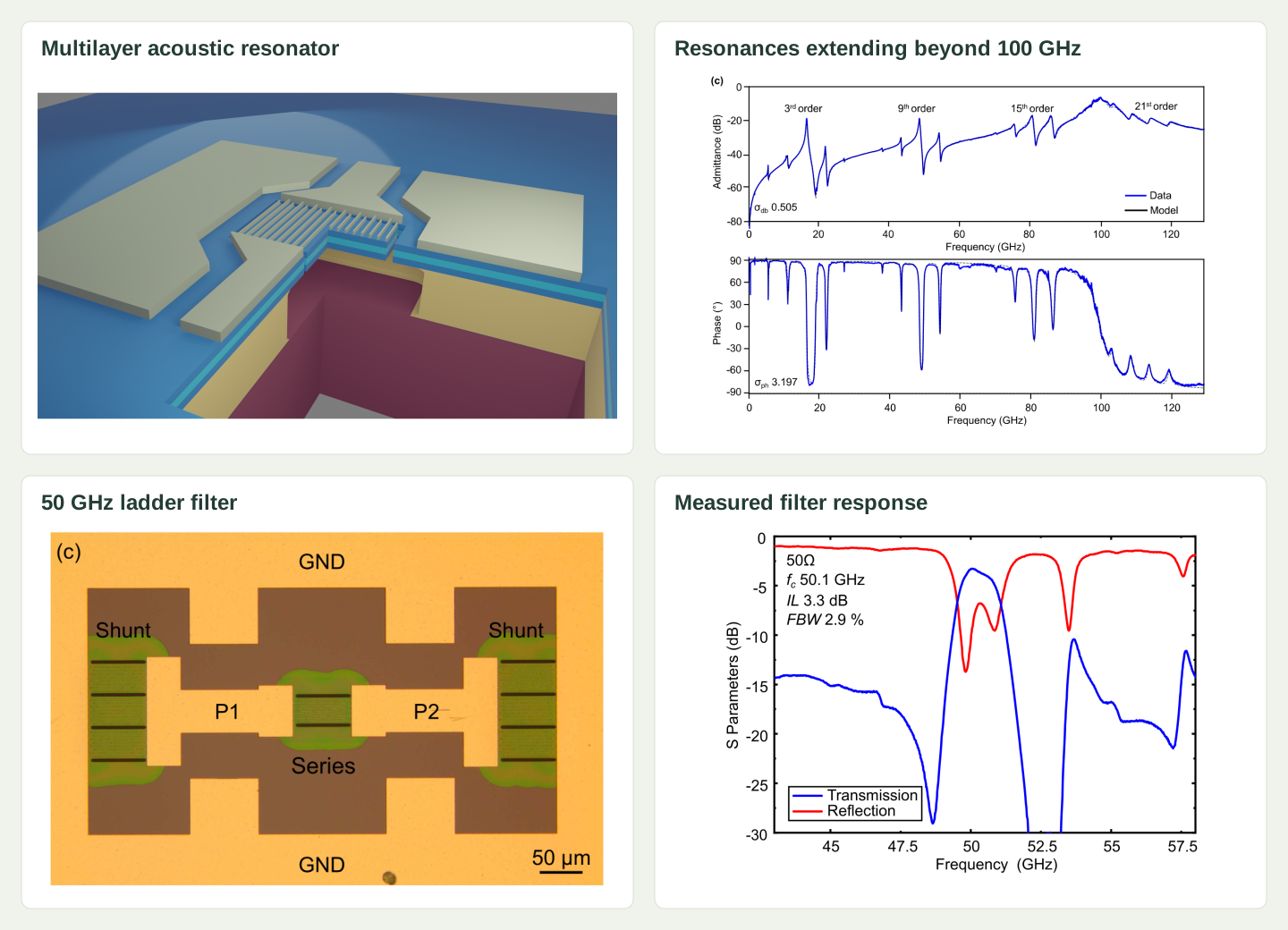
Alternating the crystal orientation across three lithium niobate layers strengthens the excitation of higher-order acoustic modes. Measurements resolve resonances extending to 115 GHz.
Kramer et al., APL (2025) ↗RUOCHEN LU GROUP / UT AUSTIN
Piezoelectric materials, RF acoustic devices, MEMS, and their integration with electronics and photonics.
Sub-THz acousticsMEMS beyond RFHeterogeneous integrationMicrofabrication and measurement
Acoustic devices can make RF filters small, but their losses and electrical connections become harder to manage as frequency increases. We develop piezoelectric resonators, filters, delay lines, and surface acoustic wave devices for RF, millimeter-wave, and sub-THz signal processing.

RESONATORS / APL 2025
Alternating the crystal orientation across three lithium niobate layers strengthens the excitation of higher-order acoustic modes. Measurements resolve resonances extending to 115 GHz.
Kramer et al., APL (2025) ↗FILTERS / JMW 2026
A four-layer lithium niobate platform brings acoustic filtering to millimeter-wave RF circuits, with a reported 3.3 dB insertion loss and 2.9% fractional bandwidth.
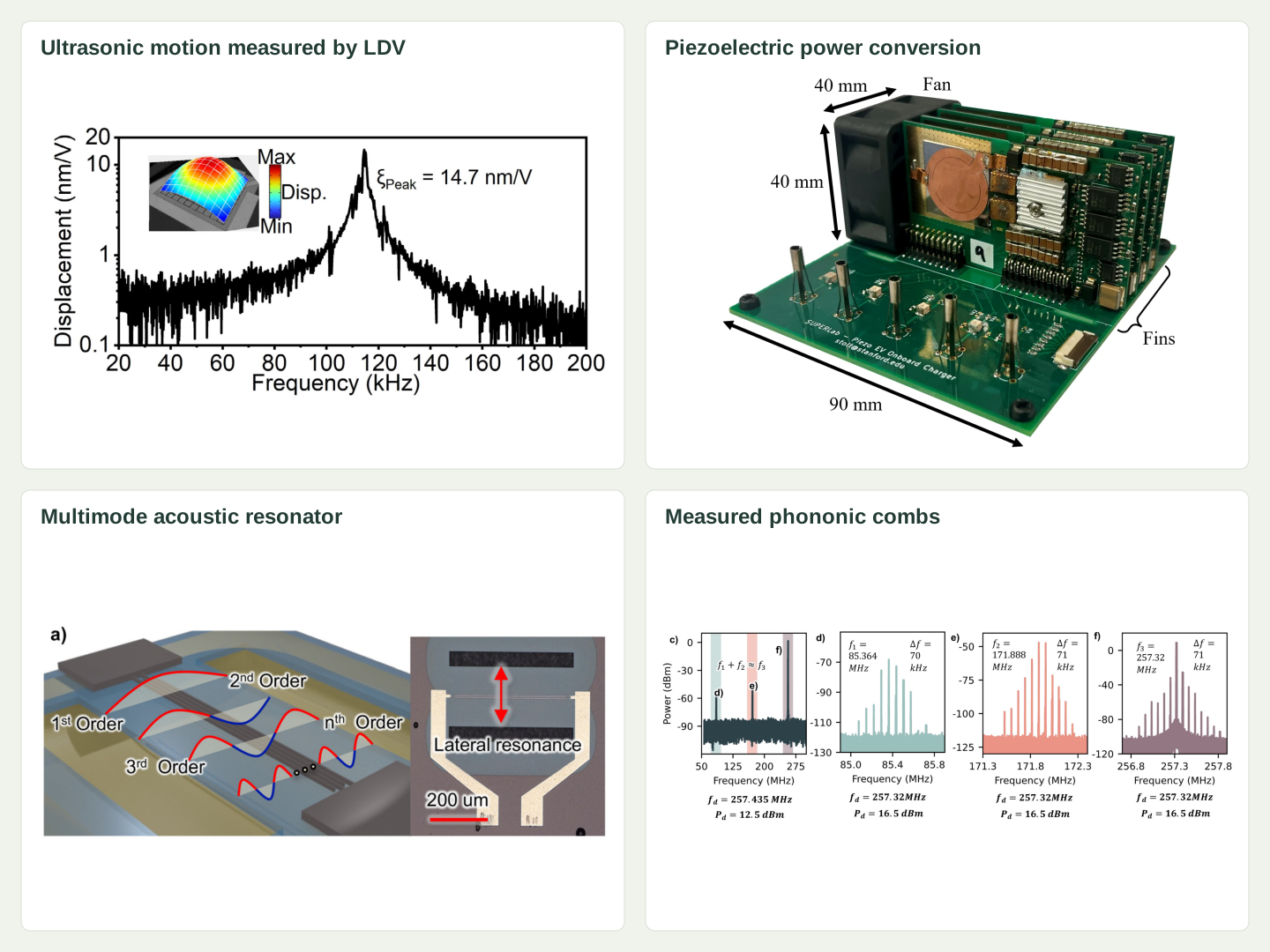
Barrera et al., IEEE JMW (2026) ↗Our MEMS work includes lithium niobate ultrasonic transducers, devices for high-temperature operation, phononic frequency combs, and piezoelectric resonators for power conversion.

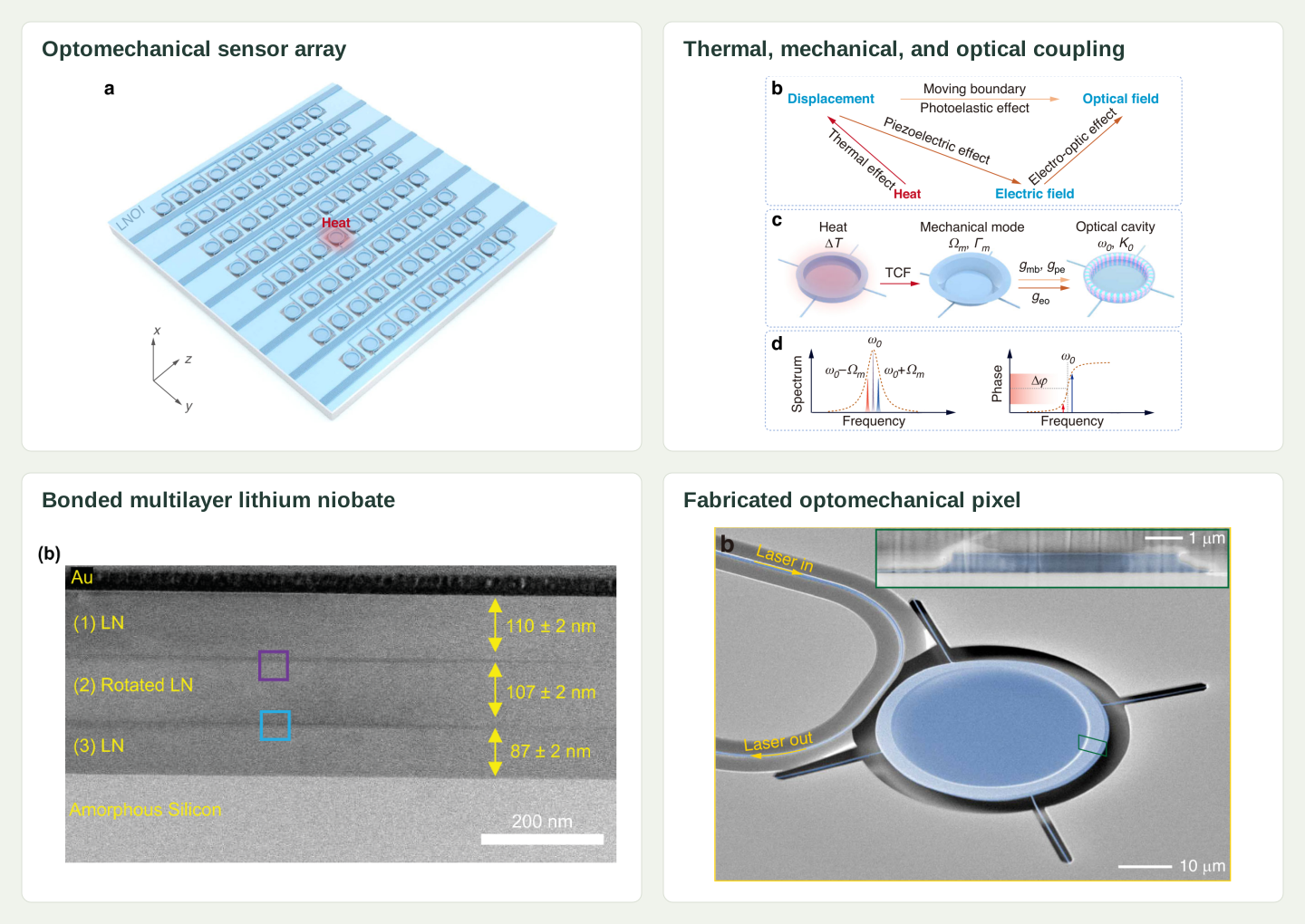
We combine piezoelectric films with electronic and photonic structures to tune RF responses and transfer signals between different physical systems. Projects include optomechanical infrared sensors, RF-driven electro-optic interactions, tunable barium titanate resonators, and ScAlN devices on acoustic reflectors. We are also investigating acoustic interfaces for quantum transduction.

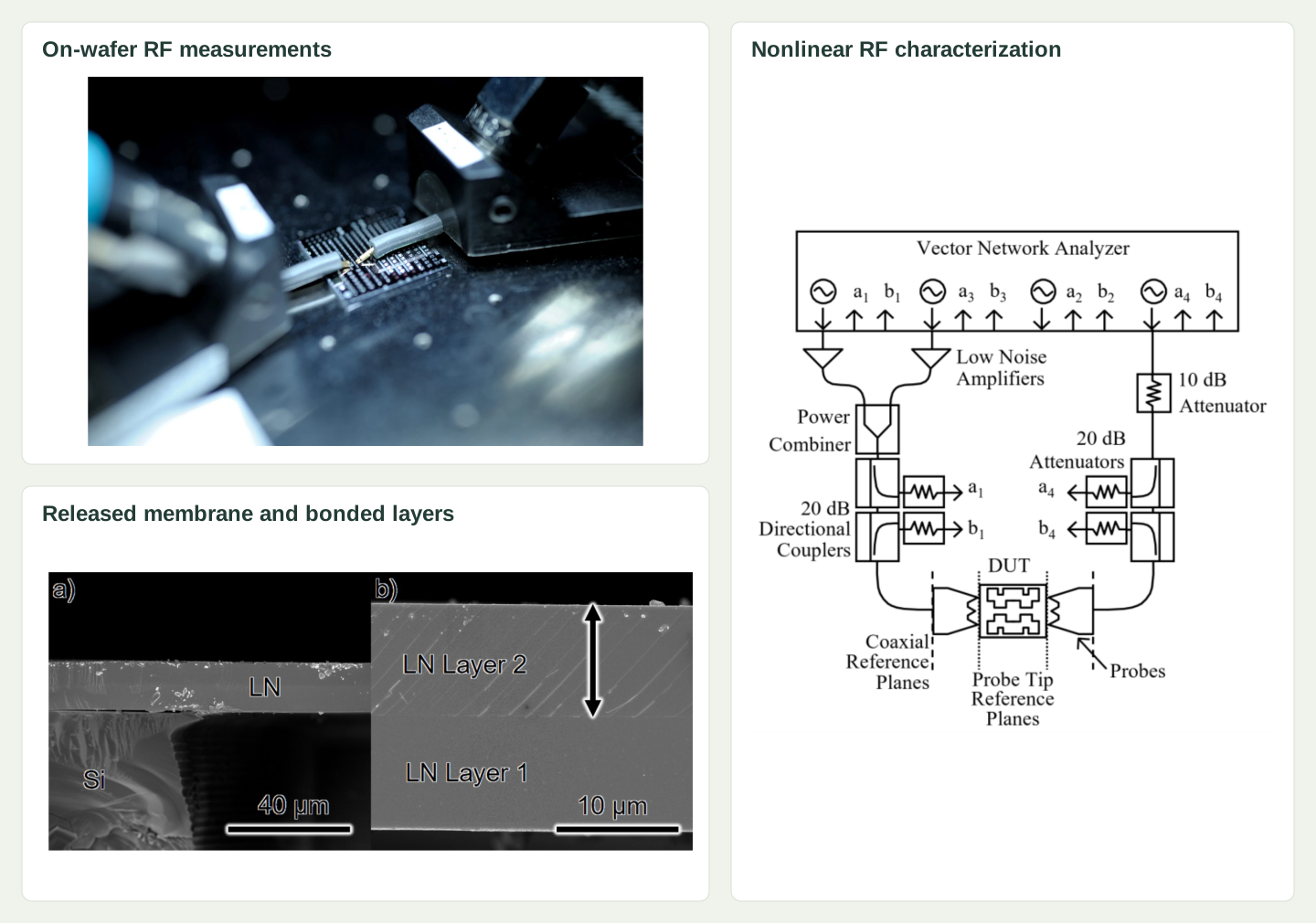
We develop thin-film fabrication processes and calibrated RF measurements to study how material quality and device geometry affect loss, power handling, and reproducibility. Measurements cover both linear and nonlinear behavior.